
Sebastián Andrés Barbieri Lemp
Associate Professor
Universidad de Santiago de Chile, Chile

Associate Professor
Universidad de Santiago de Chile, Chile



Senior Lecturer / Associate Professor
Uppsala University, Szwecja
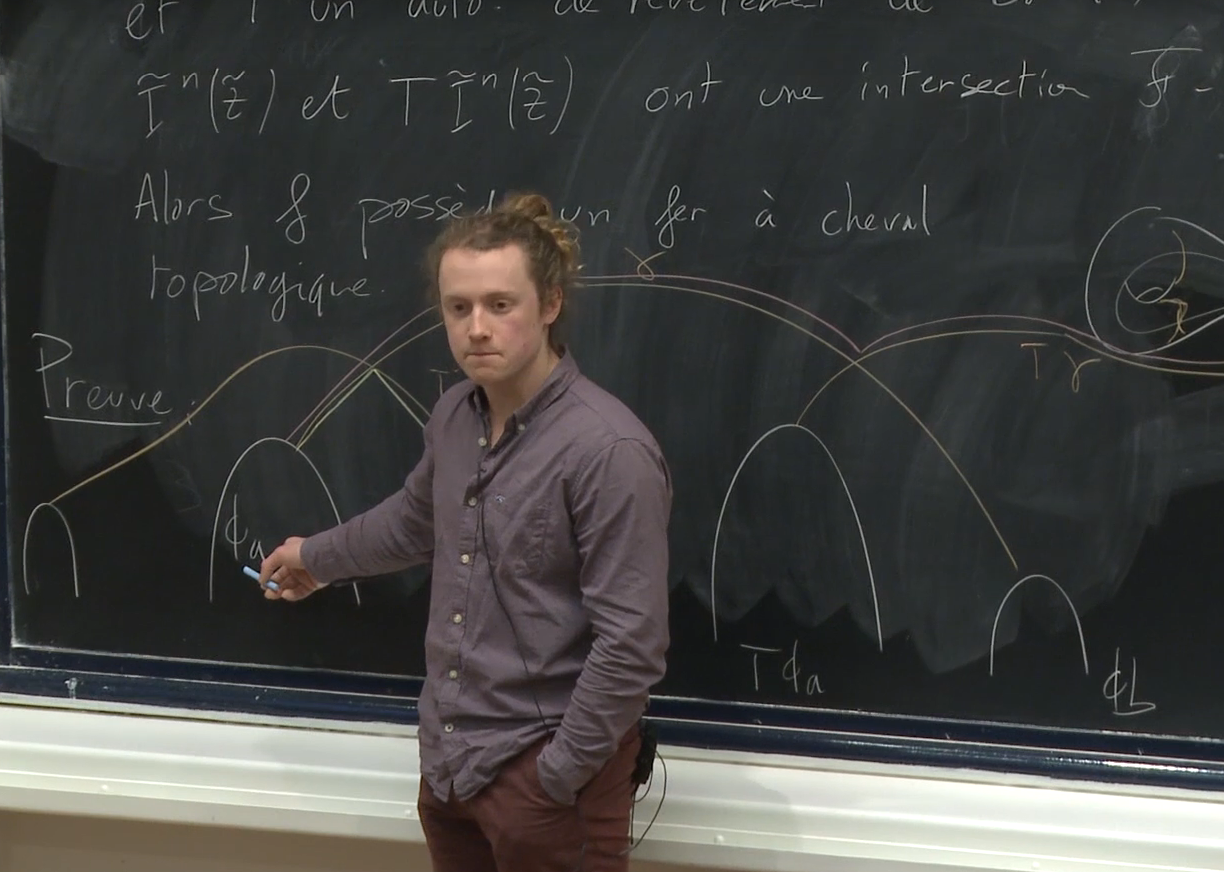

I will explore the question of what kind of dynamical systems can be obtained as topological factors of subshifts of finite type (SFTs) on a given group. We will show that if we restrict to zero-dimensional factors, then necessarily there are computational constraints on this class. Furthermore, we will show that if the group is rich enough, then every computable action can be obtained as a factor of an SFT. I will provide an overview of the classes of groups where this property holds, and those where we know it fails. We shall use this to provide two interesting characterizations of the (still open) amenability of Thompson's group F.
These talks will include a brief and gentle introduction to computability theory.
In this lecture series, we explore the construction of computer-assisted proofs (CAPs) for periodic solutions of ordinary differential equations, delay-differential equations, and partial differential equations. Our approach is based on a Newton–Kantorovich argument formulated in an infinite-dimensional Banach space of Fourier series. This framework allows us to prove that a numerically computed approximate solution of a finite-dimensional projection indeed corresponds to an actual (nearby) solution of the full differential equation.
In this course we will develop a geometric method based on the propagation of topological discs and cone conditions. The method provides a flexible framework for establishing the existence and properties of invariant manifolds and invariant sets, as well as for proving chaotic and symbolic dynamics.
When applied to Hamiltonian systems, these techniques can be used to construct mechanisms leading to Arnold diffusion, namely large changes in the action or energy resulting from arbitrarily small perturbations. The same geometric ideas also provide a powerful way of proving the existence of blenders, hyperbolic invariant sets whose invariant manifolds exhibit dynamical properties characteristic of higher-dimensional manifolds. The presence of blenders can lead to rich and sometimes surprising dynamical behaviour.
Throughout the course we will develop these ideas and illustrate them with applications to celestial mechanics, including computer-assisted proofs.
In this course, we will study how invariant quasiperiodic tori of Hamiltonian systems and symplectic maps can be computed numerically and subsequently validated by a rigorous computer-assisted proof.
We will begin with the parameterization method, in which an invariant torus is described as an embedding satisfying a functional invariance equation. This formulation leads naturally to efficient Newton and quasi-Newton algorithms based on Fourier representations. We will discuss the role of the rotation vector, the small-divisor problem, automatic reducibility, and the practical numerical implementation of these algorithms.
The second part of the course will introduce the a posteriori approach to KAM theory. Rather than constructing a torus from an integrable approximation, an a posteriori KAM theorem starts from an approximate numerical solution and proves the existence of a true invariant torus nearby, provided that its invariance error is sufficiently small and suitable nondegeneracy and Diophantine conditions hold.
Finally, we will explain how interval arithmetic and rigorous estimates can be combined with numerical computations to verify these hypotheses on a computer. We will illustrate the complete path from a numerical approximation to a mathematically rigorous existence proof. The course will emphasize both the underlying mathematical ideas and the computational techniques needed to turn KAM theory into an effective tool.
The main topic of these lectures will be validated, high order computations of invariant manifolds for dynamical systems, and applications of these expansions. Of particular interest are dynamical systems where the equations of motion are given only implicitly. In order to have a concrete example which illustrates many of the difficulties, I will focus on stable/unstable manifolds attached to periodic orbits for billiard maps. Billiards are interesting because, while the definition of the system is physically meaningful and intuitive, the map is defined by an implicit procedure rather than an explicit formula. For such a system, it is challenging to derive series expansions of dynamically meaningful objects like invariant manifolds.
I will talk about a method for computing Fourier/Taylor/Chebyshev series expansions which exploits the discrete Fourier transform. This method works very well for numerical computations with implicitly defined maps, but introduces several layers of error (round off, truncation, and interpolation/aliasing) all of which have to be managed for a rigorous computation in a computer assisted proof. Managing these requires some nice harmonic and complex analysis, which is easiest to explain for the case of Taylor series and for planar maps like the Billiards.
As an application of the validated computations explored above, I'll show how to computer stable/unstable manifolds using the parameterization method and prove the existence of transverse heteroclinic/homoclinic connections between periodic orbits.